
Why We Invested in Coast
Why did we invest in Coast? In simplest terms:
- They solved a problem I knew deeply at WorkOS
- Austin & Spencer are both incredibly talented.
The Demo Problem I Knew
In 2020, I got recruited by Michael Grinich to join an early stage startup, WorkOS, as a Developer Success Engineer.
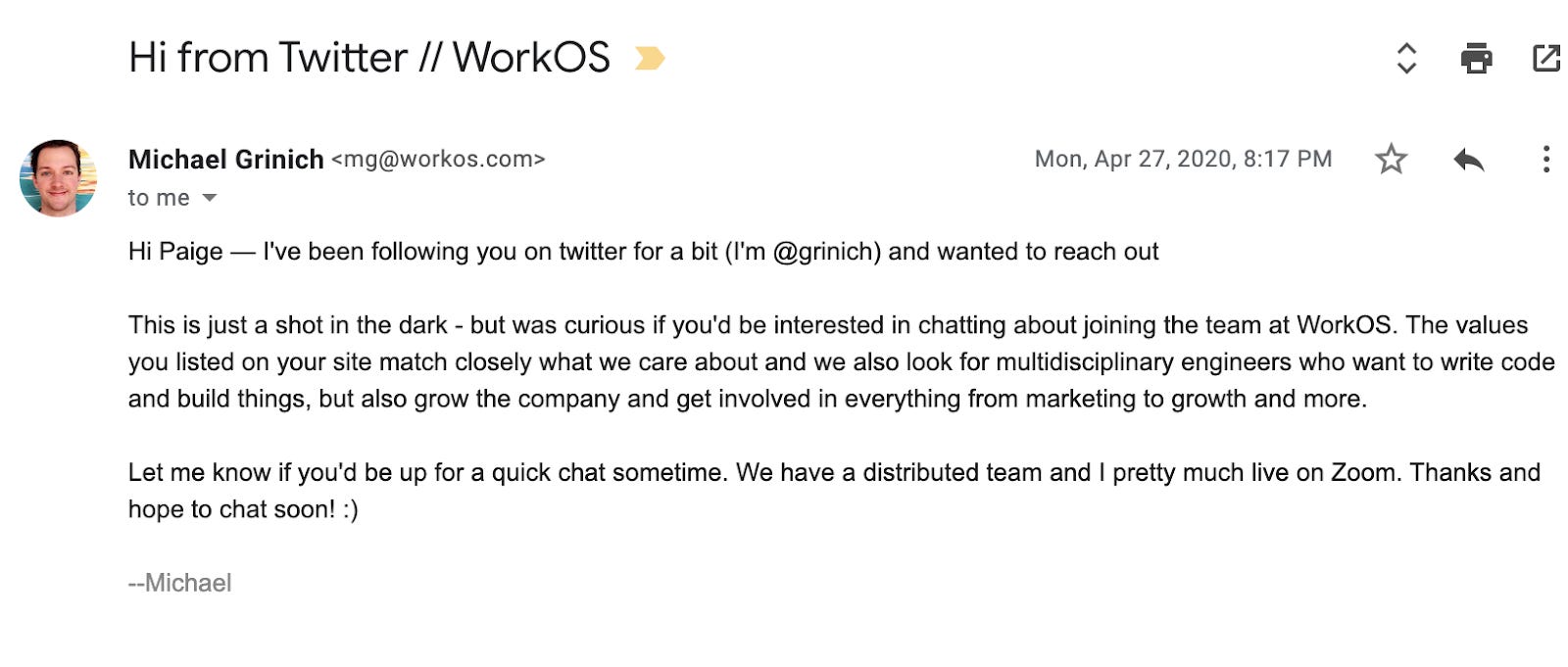
Michael’s thesis was that early stage startups will have to build Single Sign On for enterprise customers, along with a host of other features that take a while and are non-core to a product.
To prove his hypothesis, he interviewed hundreds of Chief Security Officers, and talked about his exploration in his great talk, Crossing the Enterprise Chasm.
Ironically, I had completed a market map of enterprise security at my college growth equity internship at TVC Capital.
I discovered a large whitespace in authentication infrastructure between identity providers like Okta and aggregators like Auth0. I actually searched for a solution in a WorkOS-shaped hole, but couldn’t find one.
In my role as a Developer Success Engineer at WorkOS, I mainly
- Completed demo calls for our platform with a range of business executives, CEOs, and engineers.
- Responded thoughtfully and timely to our customers integrating or troubleshooting our Slack channels
One of the core transitions WorkOS was going through at the time was making a transition from sales-led growth to a fully self-serve product led growth model.
We learned together how to go from getting on a demo call with every interested customer and Wizard of Oz man-behind-the-curtain onboarding to robust self-serve onboarding, dashboard, and docs experience. The effort our engineering and developer success teams put in every aspect of that overhaul was inspiring.
One of my challenges in this transition was completing technical demos of our product in more complex enterprise sales. I might talk to a CEO, an engineer, and a business person - so I needed to demonstrate the value of WorkOS’s product
I remember starting with a demo of a static user interface & explaining what was happening.
If it was an engineer on the call, they’d say “Well, it’s an API - can you show me what’s happening on the backend?”
The first time this happened, I asked our engineering team to help me set up a local demo-ready instance so I could demo the API running. But this wasn’t a great solution when non-technical business people asked.
Keep in mind, self-service was key at WorkOS. We had beautiful docs, a Slack channel for every single developer integrating.
But even still, this demo element specifically took months of scoping and building to figure out how to correctly display the backend element of what is happening. I knew based on our experience, many many API-first companies would also struggle with bringing their APIs to life.
Finding Coast
Less than a year after I left WorkOS to go full time on building Behind Genius, one of our operator LPs, Shawn Basak, shared a company with us, with the following email:
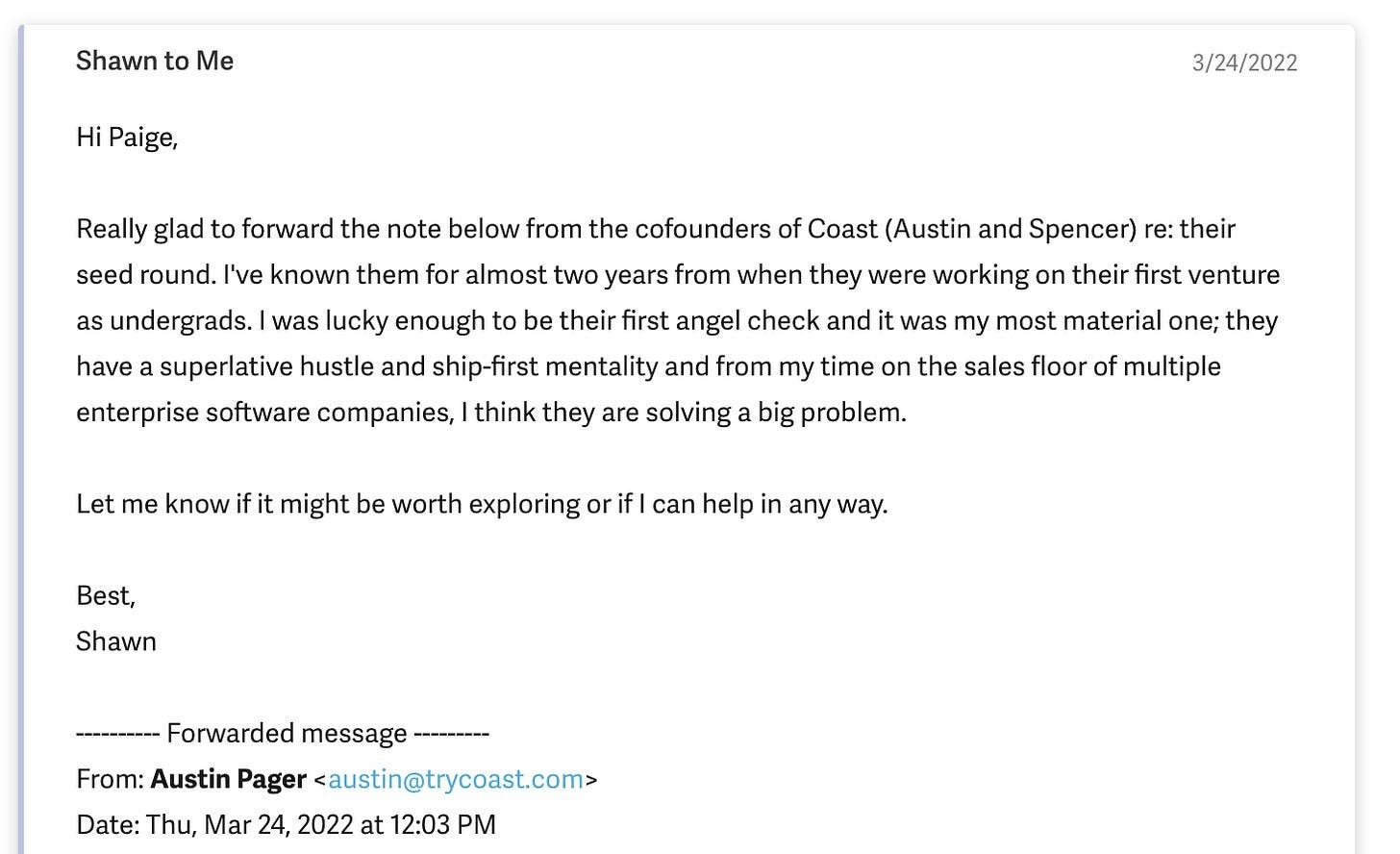
I scrolled down further to see the forwardable:
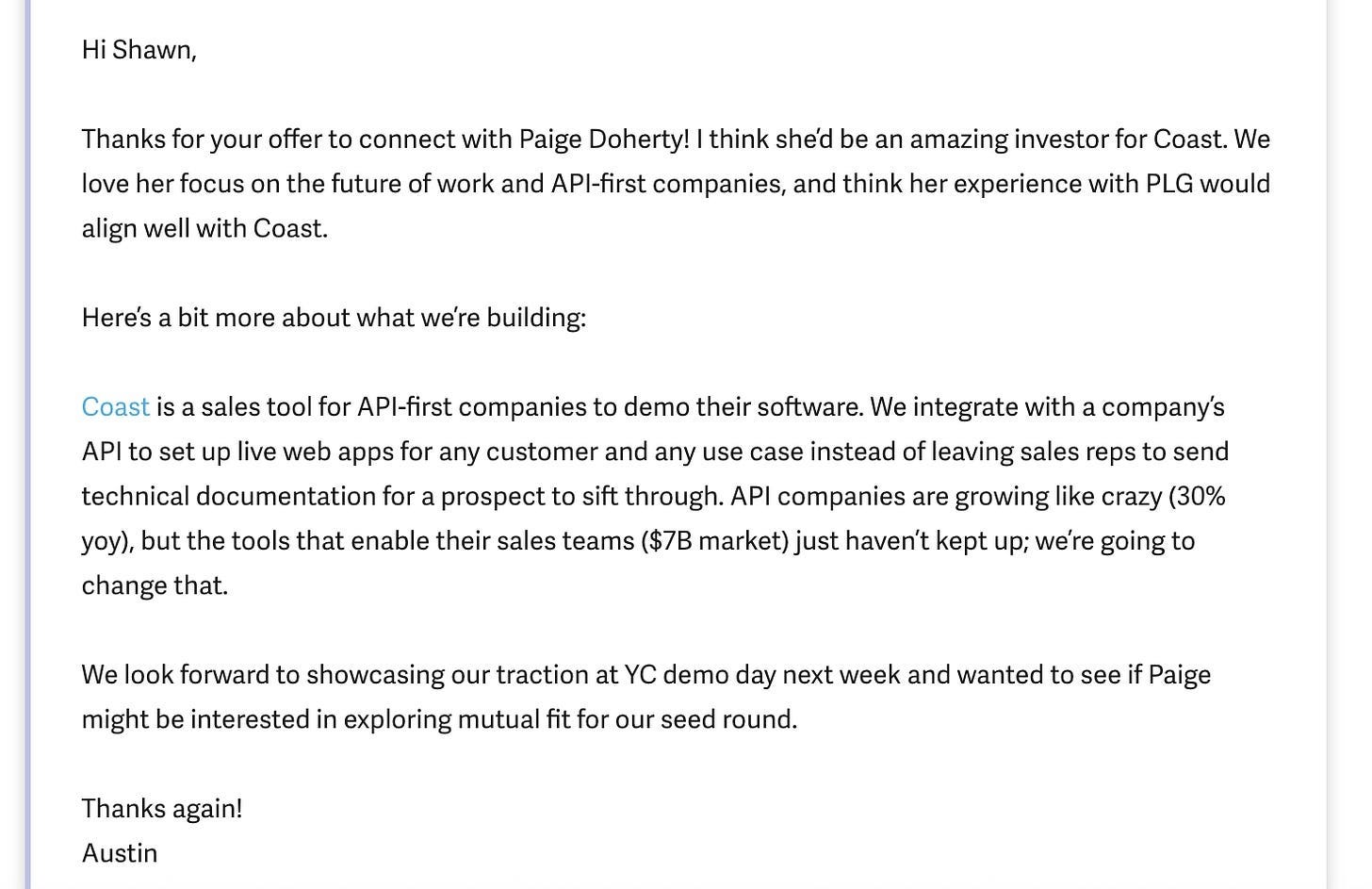
It was one of those lightbulb moments where I was like “duh, this needs to exist.”
I don’t think Austin [Pager] & Spencer [Levitt] even pitched me on our first call. They are both incredible storytellers and have technical backgrounds, so we discussed different architecture challenges and how to think about their own self-serve motion.
The team was still pre-revenue at the time, but I had the conviction that Coast would help the many API-first companies that needed a better way to demo their products.
As they finalized allocation in their oversubscribed round, we were lucky enough to land $200k in allocation alongside YC and Brickyard.
When I asked Austin why they let us invest, he said
“Paige was a no-brainer to join the round given her hands-on experience as our ICP given her time at WorkOS. From our very first call it was clear she understood the problem we aimed to solve and was ready to get her hands dirty to help us succeed.”
As one of our early LPs and mentors Andy Weissman, General Partner at Union Square Ventures, reminded me on my trip to New York: “You’re always going to have some success bias in writing when things go well.”
Since We Invested...
I tried my hardest to remain unbiased in this piece, but today, Coast serves some of the largest fintech platforms in the world.
From a recent API Economy article explaining Coast:
“FIS (NYSE: FIS), whose APIs help process $50 trillion annually and are used by 95% of the world’s leading banks, trusts Coast to power how they showcase the capabilities of their APIs…
In addition to working with some of the top US banks, credit bureaus, card networks, and other Fortune 500s, Coast also works with leading API-first companies, like Twilio and Plaid, which are largely credited with creating the notion of an API-first company.”
They’re quickly (and profitably) scaling, without needing to raise capital since their first and only round.
I asked Austin recently for a quote about how it’s been working together over the past three years. He shared the following:
“Paige has been one of the most founder-friendly investors on our cap table. She doesn’t just offer advice, she introduces us to potential customers and top-tier candidates. She’s made a real impact on our business.
Working with Paige feels like having a true extension of our founding team. She consistently opens doors to customers and new hires, and is always there for us when we need it the most.”
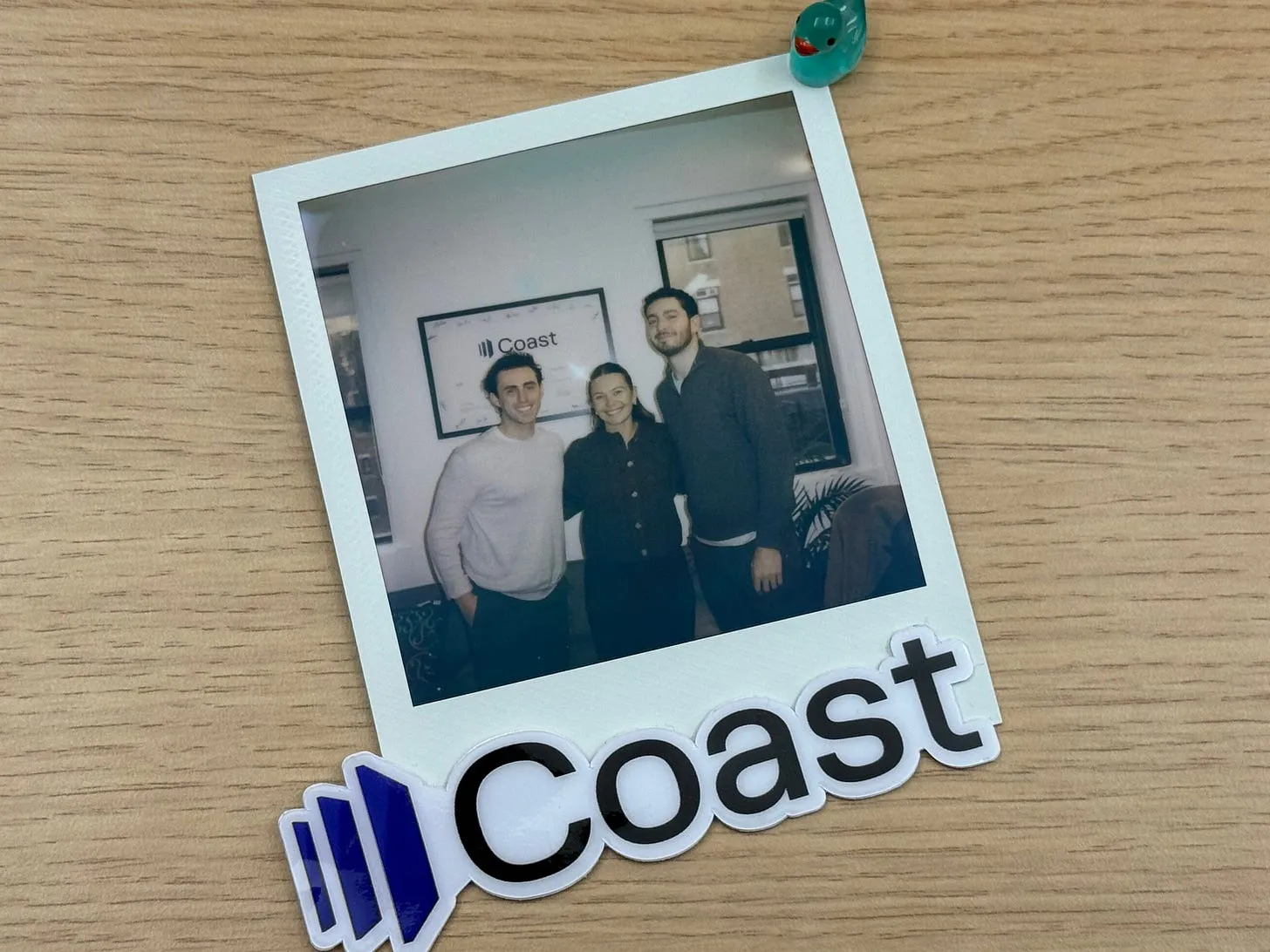
I got to visit Coast’s new New York office last month (hence the above Polaroid), and it was incredible to see how their team had grown.
We are honored to continue supporting the Coast team, and if you’re looking for a new role, please check out the current NY-based roles the team has open: https://www.ycombinator.com/companies/coast/jobs
Behind Genius Ventures

