
Why We Invested in Intermezzo
Imagine you are the CFO of a company.
Your company just solved their biggest bottleneck: engineering talent. They scouted and found an incredible team of developers in Brazil, highly skilled, cost-efficient, and ready to start immediately.
But you had to make the painful decision to shut the entire expansion down.
Why?
You simply couldn't figure out the payroll compliance risks. Every Human Capital Management (HCM) platform you asked gave you a different, vague answer about tax liabilities and labor laws. The "modern" global payroll stack was so opaque that you decided it was safer to stop the expansion than deal with unclear compliance risks.
This isn’t a hypothetical.
This is a real story Siddharth Ram and Kumar Ramanathan, the cofounders of Intermezzo, told us from their time in the trenches of payroll at Velocity Global.
It illustrates the silent killer in expanding global opportunity: a broken payroll infrastructure.
Finding Intermezzo
We were introduced to the founders of Intermezzo through John Zeratsky from Character Capital, who led their preseed round.
Paige, our founding partner, forwarded me the materials, and exactly four minutes later, I wrote back: "Yes, this is very interesting. I would want to take a call"
When Intermezzo came across our desk, we had just completed a deep-dive study on the last 100 $1B+ exits in tech, What It Takes, and Intermezzo shared three key elements we’d noticed:
- Horizontal Application: Payroll is a fundamental infrastructure layer.
- Massive Market: Payroll is a universal need, covering virtually every business on earth.
- Technical DNA: The founders, Sid and Kumar, weren't just industry veterans; They had spent many years working around these problems at companies including Intuit and Velocity Global.,
Noticing those three elements caused me to lean in quickly to take a first call.
In our first meeting, Sid and Kumar were able to articulate payroll’s dirty little secret so clearly.
Payroll’s Dirty Little Secret
To the average employee, payroll seems solved. You log into a modern portal (like Rippling or Deel), check your paystub, and the money appears.
But ask anyone deep in the industry, and they will tell you the dirty little secret: the infrastructure powering that modern UI is ancient.
Most "modern" payroll providers don't actually do their own gross-to-net calculations. They rely on a patchwork of aggregators, local third-party vendors, and legacy backend engines that date back to the 1980s.
In a world of AI and instant API connectivity, the most critical function of business, paying people, is still running on "duct tape and chewing gum."
Not only that, but payroll is incredibly complex: The U.S. alone has over 10,000 separate tax jurisdictions across federal, state, county, city, and school district levels. Certain states, like Pennsylvania and Ohio, have thousands of localized tax authorities, each with its own rules and deadlines.
In Europe, countries such as Germany have detailed local regulations on top of national ones, plus complicated social insurance schemes. These overlapping, ever-changing tax laws introduce significant complexity and make it easy to miscalculate withholdings.
After they described this massive problem, I immediately wanted to hear how they were planning on disrupting such a legacy industry.
The Solution: The "LLM Sandwich"
What’s unique about Intermezzo’s approach is they are actually rebuilding the payroll engine.
They are an API-first platform solving the hardest problem in the stack: the deterministic calculation of gross-to-net pay across complex global jurisdictions.
What compelled us most was their architectural approach, which they call the "LLM Sandwich":
- The Intake (LLM Layer): They use Large Language Models to ingest and digitize complex, ever-changing tax laws and government PDFs (like the thousands of pages of German tax code).
- The Core (Deterministic Graph): Crucially, they do not use AI to do the math (which creates hallucination risk). Instead, the system converts laws into a computational graph. This ensures 100% accuracy and deterministic execution. If you run the payroll a million times, you get the same result a million times.
- The Output (Explainability Layer): The top layer uses AI to explain the why. A user can ask, "Why was $28 deducted from my check this week?" and the system can trace the specific logic node to provide a plain-English answer.
This architecture allows them to tackle the hardest jurisdictions first, like Germany (with its complex social insurance laws ).
Demonstrating Conviction
In venture you are always looking for something with asymmetric upside. After the first call, I felt that I had found something.
Immediately after that first call wrapped up, I called Paige’s cell to pound the table:
"We need to invest in this. What they're building is super interesting."
Paige and I reconnected with Sid and Kumar later that same afternoon, and Paige was equally impressed by what they were building. She had even felt the pain point Sid and Kumar described with her own remote hiring experience.
As our team reflected on the opportunity, three key elements anchored our conviction:
- Deep Domain Expertise: Their deep understanding of both modern software development and legacy payroll operations is a rare combination. Tackling the global payroll problem requires not only next-level engineering but also domain know-how, especially around regulatory compliance and country-by-country nuances. Sid and Kumar’s backgrounds and first-hand experiences uniquely position them to solve these challenges.
- Leading-Edge AI + Deterministic Execution: Their rapid build of a multi-jurisdiction payroll engine showcases serious engineering speed. We’re especially drawn to their “LLM + deterministic graph” model, which ensures ironclad accuracy and reliability—exactly what mission-critical payroll requires. This blend of swift product velocity and deep technical chops is a true competitive edge.
- Potential to Become an HR-Operations Platform: Payroll is central to everything HR touches—time tracking, benefits, compliance, cross-border tax filing, and more. We see a natural, strategic path to expand into adjacent services once they secure a foothold, making their platform even more indispensable over time.
Throughout our conversations, we clearly demonstrated this conviction and the concrete, hands-on ways we could actively support the team.
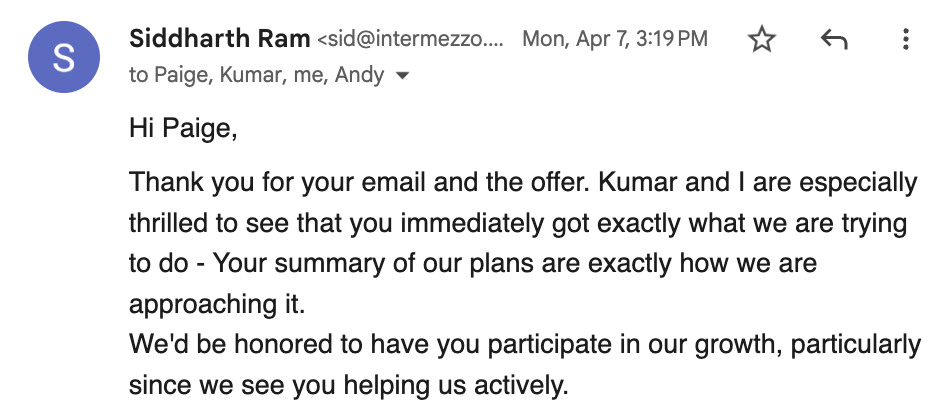
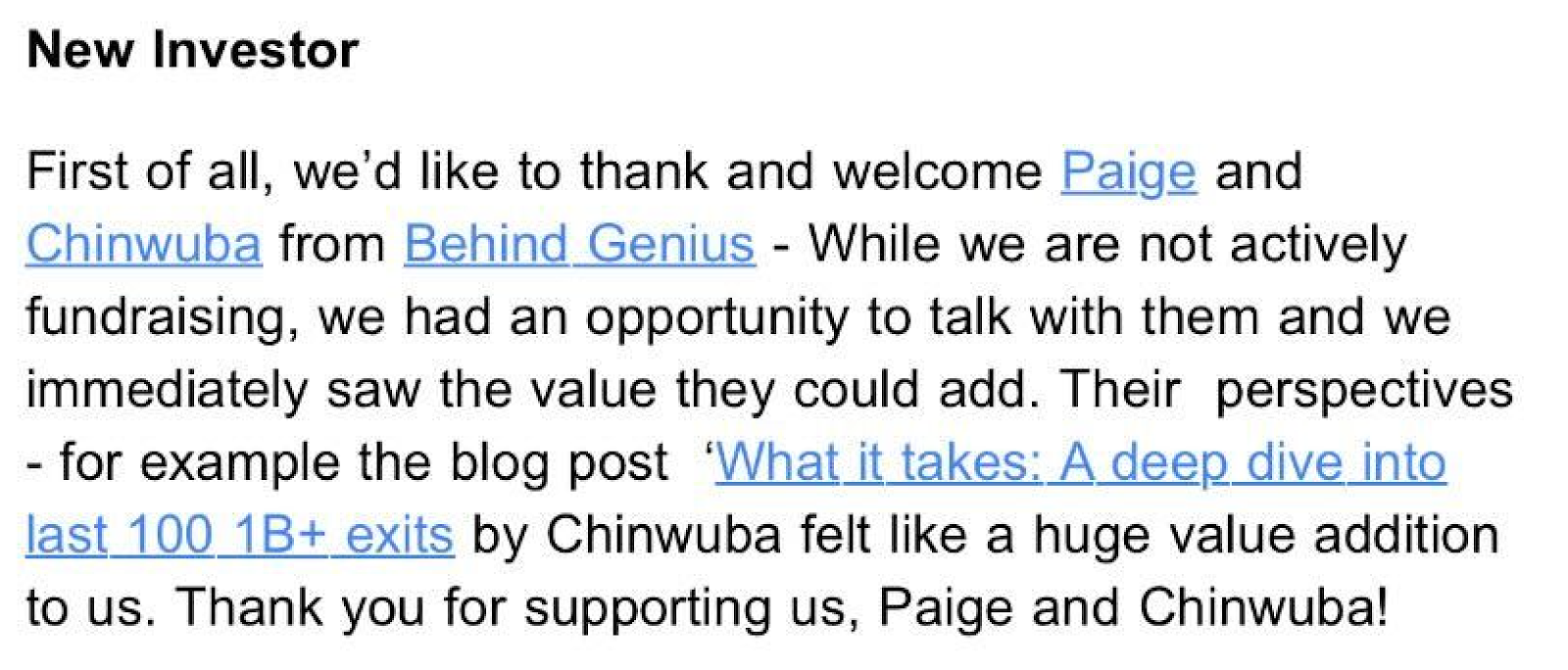
That alignment and credibility ultimately earned their confidence and led them to have us invest even though they weren’t actively raising.
Intermezzo Secures Key Partner
Since our investment, Intermezzo has secured UKG (~$20B HR Platform) not only as a customer, but also as a strategic investor.
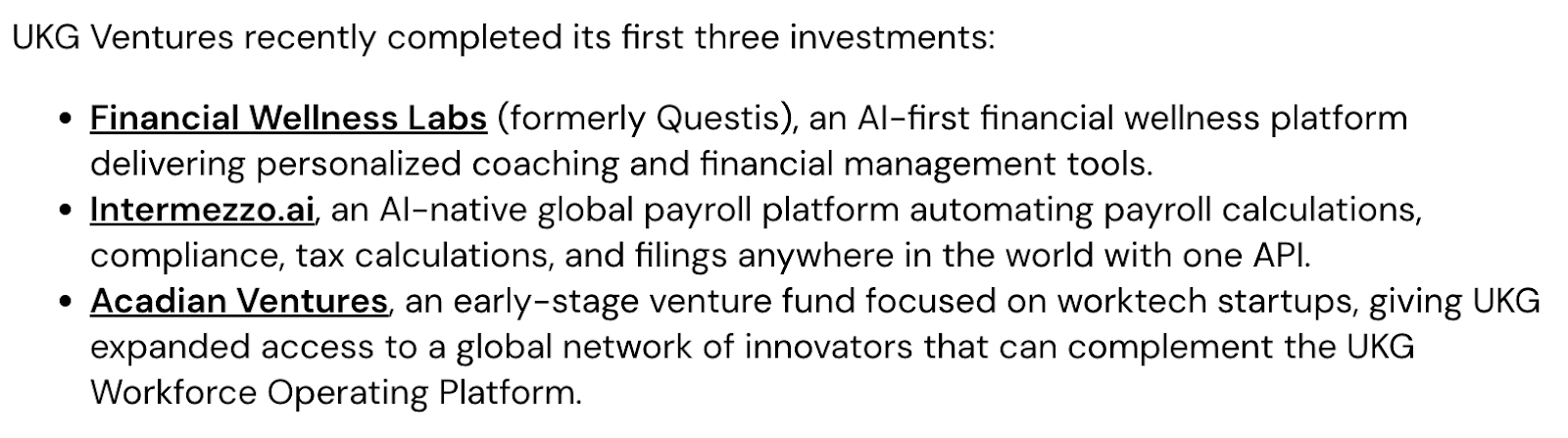
Sid and Kumar are exactly the kind of domain-expert founders we back at Behind Genius: founders willing to “eat the frog” by tackling the hardest part of the system first. Our team has supported Intermezzo through enterprise pricing research, company storytelling, and meaningful coinvestor introductions.
You can learn more in Kumar’s presentation here from our Third Annual Summit, in April 2025:
If you’re a domain expert building in a legacy industry, we’d love to hear from you. Behind Genius is an early stage venture firm focused on investing in technical storytellers, especially domain experts like Sid and Kumar.

Behind Genius Ventures

